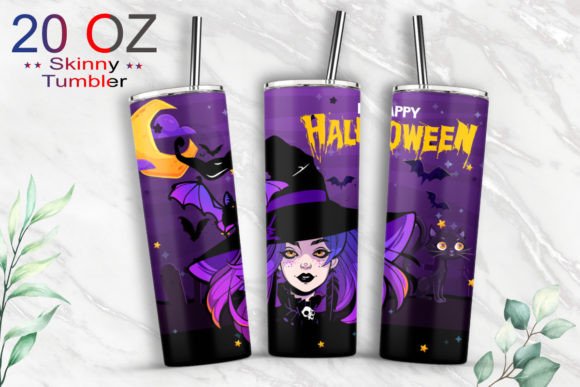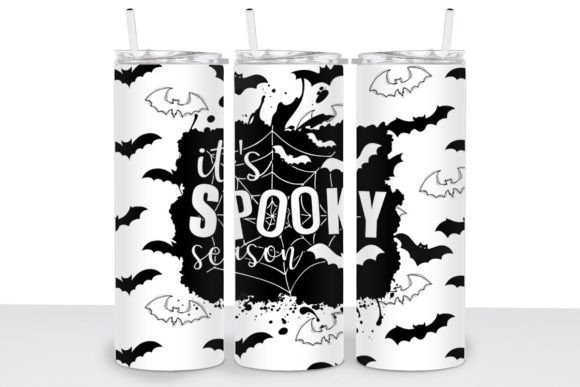
Halloween Spooky Season Tumbler Wrap
As a designer who’s stitched over 300 Halloween-themed embroidery projects — from boutique baby onesies to craft-fair aprons and Etsy bestsellers — I opened the Halloween Spooky Season Tumbler Wrap expecting something cheerful but generic. What I found was sharper than most sublimation-inspired graphics: a tight, rhythmic layout built for repetition, not just decoration. It’s clearly designed for cylindrical surfaces — think tumblers — but its real strength lies in how well it translates to flat, stitched applications when treated with intention.
First Impressions: A Design That Breathes (and Stitches)
The mood is playful-haunting — not scary, not cutesy. Bats, pumpkins, and “Happy Halloween” lettering sit in balanced rhythm, with intentional negative space between elements. That breathing room matters more than you’d think: it keeps satin stitch outlines crisp on sweatshirt fleece and prevents fill-stitch bleed on lightweight tea towels. Unlike many “spooky season” graphics that cram too much into one frame, this one feels curated — like it was made by someone who’s actually hooped a cap before.
A Real-World Test: Embroidering a Linen Kitchen Towel Set
Last week, I used the Halloween Spooky Season Tumbler Wrap as the centerpiece for a limited run of embroidered linen kitchen towels — meant for a local gift shop’s October launch. I resized it to fit a 4x4 hoop (centered vertically, with “Spooky Season” as the anchor line), added a subtle running-stitch border for framing, and ran it on medium-weight cutaway stabilizer. The result? Clean, legible, and instantly recognizable — even at 12 inches away. Customers didn’t just say “cute”; they said “I know exactly where this belongs.” That kind of intuitive resonance is rare in print templates.
Where It Shines — And Where It Needs Caution
This design excels on stable, midweight fabrics: cotton twill for tote bags, brushed poly-cotton for sweatshirts, and linen-blend pillow covers. As a machine embroidery design, it holds up beautifully on custom apparel — especially when paired with tone-on-tone thread (e.g., charcoal gray on heather black). On baby embroidery? Yes — but only if you simplify the lettering or skip the smallest decorative accents. Tiny bats under ¼ inch won’t resolve cleanly on newborn onesies without significant digitizing tweaks.
Proceed carefully on:
- Stretchy fabric — like ribbed knit caps — unless you use tear-away + topping and reduce stitch density manually;
- Dark or textured backgrounds — test thread colors first; white satin stitch can disappear on deep navy terry cloth without a light underlay;
- Curved surfaces — while designed for tumblers, stitching it *around* a curved mug sleeve requires careful hooping and possibly splitting the design;
- Small hoop sizes — below 3.5 inches, the “Happy Halloween” text loses legibility without re-digitizing;
- Frequent-wash items — like kids’ tea towels — confirm your fill stitch density isn’t so heavy it’ll stiffen or crack after 15+ cycles.
Design Integrity Meets Commercial Practicality
What makes the Halloween Spooky Season Tumbler Wrap valuable for Etsy sellers and small shop owners isn’t just its theme — it’s its adaptability. You can use it straight from the file as a digital embroidery file for patches, or deconstruct it into standalone motifs (bat, pumpkin, wordmark) for mixed-media holiday embroidery kits. As a graphics asset, it works equally well in printable mockups for social media listings — no pixelation, clean edges, consistent spacing.
That consistency builds customer trust. When buyers see the same confident spacing and balanced weight across your embroidered tote bag design, sweatshirt embroidery, and holiday gift set, they subconsciously register professionalism — not just “handmade,” but *thoughtfully handmade*. And for craft business owners pricing personalized gifts, that perceived polish justifies a 15–20% premium over generic Halloween fonts.
Practical Designer Notes Before You Stitch
Before committing to a full production run:
- Run a test on scrap fabric matching your final product’s weight and stretch;
- Check thread color contrast — especially on dark or variegated fabric textures;
- Review stitch density: high-fill areas (like pumpkin centers) may need reduced density for softness on baby embroidery;
- Confirm hoop size compatibility — don’t assume it fits your standard 4x4 without checking dimensions;
- Inspect small details in black-and-white mockups — what reads as “charmingly detailed” on screen may read as “muddy” in thread;
- Use appropriate stabilizer: cutaway for knits, tear-away for stable wovens, and always a light topping for napped fabrics;
- Verify licensing terms — since this is a digital product only, confirm whether resale of finished embroidered items is permitted, and whether redistribution of the file itself is restricted;
- Compare performance on light vs. dark backgrounds — sometimes reversing the color scheme in your embroidery software improves clarity more than changing thread.
Final Thought: A Reliable Workhorse, Not Just a Trend
The Halloween Spooky Season Tumbler Wrap won’t replace your custom-drawn signature designs — and it shouldn’t. But as a versatile, commercially sound print template, it fills a quiet but critical gap: dependable seasonal relevance without visual fatigue. It’s the kind of embroidery project starter that lets you focus on execution — fabric choice, thread pairing, presentation — rather than wrestling with weak spacing or unreadable lettering. For makers building a repeatable holiday collection, or Etsy sellers refreshing their October listings with confidence, this isn’t just another graphic. It’s a quietly capable partner — stitched, sold, and trusted.