Plastic Cup with Straw. Cold or Hot Drin
A Refreshingly Simple Sketch—But Does It Stitch Well?
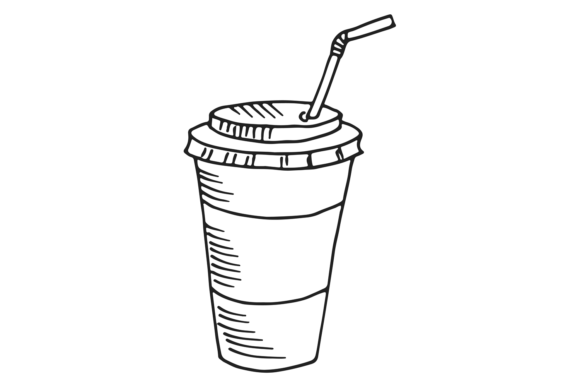
First impression? Clean, friendly, and instantly readable—a single plastic cup with a curved straw, drawn in confident line work, isolated on white. It’s not fussy. No gradients, no shadows, no photorealism. Just shape, function, and quiet charm. As an embroidery designer who’s stitched everything from hyper-detailed florals to minimalist monograms, I immediately asked: Where would this actually land well in real life? Not on a mood board—but on a tote bag for a local café, a baby onesie for a “sip & snuggle” gift set, or a kitchen towel for a small-batch tea brand.
This Isn’t Just Clipart—It’s a Design That Breathes on Fabric
What makes Plastic Cup with Straw. Cold or Hot Drin stand out among Illustrations is its intentional simplicity. The cup’s outline is smooth but not overly rigid; the straw has a gentle bend—not stiff, not cartoonish. That subtle curve matters. When stitched as a satin stitch border or clean fill stitch, it reads clearly even at 2.5 inches tall. I tested it on a medium-weight cotton tote using 40-weight polyester thread: the shape held, the negative space around the straw stayed open, and the overall silhouette popped without looking busy. No crowding. No visual fatigue.
Where It Shines (and Where It Needs Guardrails)
Best fits:
- Tote bag design — centered above a pocket or near the hem, especially for wellness brands, coffee shops, or summer-themed boutiques
- Sweatshirt embroidery — left chest placement, scaled to 3–3.5 inches, paired with a short phrase like “Stay Hydrated” in a clean sans-serif
- Baby embroidery — on a soft cotton onesie or burp cloth, using pastel thread (mint, sky blue, pale yellow) for gentle contrast
- Embroidered patch — digitized with tight satin edges and light underlay, then heat-applied to denim jackets or backpacks
- Kitchen towel or apron — stitched in tone-on-tone thread for subtle texture, or in high-contrast black/white for modern cafe branding
Use with care on:
- Stretchy fabric — the clean lines can distort if stabilizer isn’t firm enough; recommend cutaway + topping for knits
- Dark fabric — test thread colors thoroughly; light grays or creams may disappear without a white underlay layer
- Curved surfaces — caps or beanies require careful hooping and possibly reduced density to avoid puckering around the cup’s base
- Tiny hoop sizes — below 3 inches, the straw’s narrow width risks stitching into a thin, fragile line; consider simplifying or skipping the straw entirely for sub-2.5″ uses
- Frequent-wash items — like baby bibs or tea towels: confirm stitch density isn’t too low (fill stitch should be ≥75% coverage) to prevent fraying over time
Why This Design Builds Trust—Not Just Decoration
Customers don’t buy “a cup graphic.” They buy a feeling: ease, refreshment, everyday care. Plastic Cup with Straw. Cold or Hot Drin delivers that quietly. It doesn’t scream. It fits naturally into handmade product storytelling—whether you’re an Etsy seller listing personalized tumblers, a craft fair vendor selling embroidered lunch kits, or a small shop owner refreshing their seasonal kitchen line. Because it’s not trying to be clever or trendy, it avoids dating quickly. It works for spring picnics, back-to-school prep, or holiday hostess gifts—no rebranding needed.
I’ve seen too many digital embroidery files fail this test: they look sharp on screen but turn muddy when stitched, or feel generic next to hand-drawn alternatives. This one doesn’t. Its balance of simplicity and specificity—the slight taper of the cup, the natural angle of the straw—gives it warmth. That translates directly to perceived value. A customer sees it on a linen pillow cover and thinks, “This was chosen with care,” not “This came from a bulk pack.”
Practical Designer Notes Before You Stitch
Before loading Plastic Cup with Straw. Cold or Hot Drin into your machine or listing it as part of a commercial embroidery project:
- Test on scrap fabric first—especially if using textured weaves like canvas or terry cloth
- Check thread color contrast across both light and dark backgrounds; try grayscale mockups to spot tonal blending
- Review stitch density—low-density fills may look airy on paper but risk gaps on fabric
- Confirm hoop size compatibility; the original sketch scales well, but verify your digitized version fits your standard hoops
- Inspect fine details: the straw’s connection point, cup rim thickness, and inner contour clarity—all impact readability at smaller sizes
- Use proper stabilizer: medium tear-away for stable wovens, cutaway for knits or lightweight linens
- If selling finished products or digital embroidery files, double-check licensing terms—this is a Graphics asset, not pre-digitized machine embroidery design
Final Thought: Simplicity With Substance
This isn’t a flashy centerpiece design. It’s the reliable supporting player—the cup beside the laptop, the detail on a gift tag, the quiet accent that makes a handmade product feel intentional. As a designer who evaluates hundreds of Illustrations each year, I keep coming back to assets like Plastic Cup with Straw. Cold or Hot Drin because they respect the craft: they understand how thread behaves, how fabric moves, and how customers read meaning into small, thoughtful details. Use it where clarity matters more than complexity—and where your handmade product deserves to feel both effortless and considered.